


By ANDREW TSANG
Healthcare solely business within the room to your first breath – and it payments you for it.
The one business within the room to your final one – and its declare outlives you.
The one business that hires extra people yearly to maintain all people else.
The one business whose finest work is the illness you by no means knew was coming.
The one business that’s left holding the smoker’s lungs, the drinker’s liver, and the soda child’s blood sugar – lengthy after everybody else has cashed out.
The one business that also wants an individual on the bedside when the machines do the remaining.
The one business that has almost a fifth of the whole lot we make, and continues to be rising.
Healthcare ought to continue to grow. It’s the solely business whose complete product is human capability—extra years, and extra skill to make use of them. It’s the solely business that takes within the harm each different business leaves behind. I don’t care how massive tech, retail, autos or manufacturing get. Previous some extent we cease wanting extra of what they promote, and none of them will get handed the invoice for anybody else’s hurt. As their machines take over extra of the work, healthcare is the place our cash, our folks, and our ambition ought to go. It can develop into no matter we pay it to do.
We often deal with that progress as proof of failure when it’s not. I learn sufficient healthcare articles to recite the proof with my eyes closed: $5.3 Trillion, 18% of GDP, more than $15,000 per person, roughly 24 million jobs in healthcare and social help. And sure, the invoice is just too excessive, and we’ll get to that later.1 However lots continues to be lacking, like cures for illnesses we are able to’t but deal with, appointments folks can’t get, and sufficient nurses for the sufferers already within the beds. Each a kind of would make the business larger, and each one in every of them is price shopping for. And who cares if extra of our cash goes to well being – what if the purpose of getting richer is to purchase extra life?
That sounds backwards principally due to one phrase. Calling healthcare an business makes folks uneasy for good motive. A health care provider turns into a supplier, a affected person turns into a client, and somebody having a coronary heart assault turns into a market alternative. However vehicles take us locations, telephones allow us to speak to folks, and movies give us one thing to argue about afterward. Healthcare offers us extra time and extra skill to do any of it. The difficulty is deciding how a lot of its progress buys extra life, and the way a lot buys extra enterprise.
5 Trillion is Chump Change
Healthcare is oft-cited as a $5.3 Trillion business – as if that meant something in any respect. It would as properly be the dimensions of Jupiter; the dimensions doesn’t even register. So I don’t flinch at 18% both. Healthcare is eighteen% of the economic system. 18% of GDP. 18%, and climbing. Everybody who mentions 18% says it like a prognosis, and say 18% sufficient instances and it stops that means something. I feel 18% is just too little. What healthcare makes is extra years and extra skill to make use of them, and that’s the one factor folks preserve wanting extra of as they get richer.
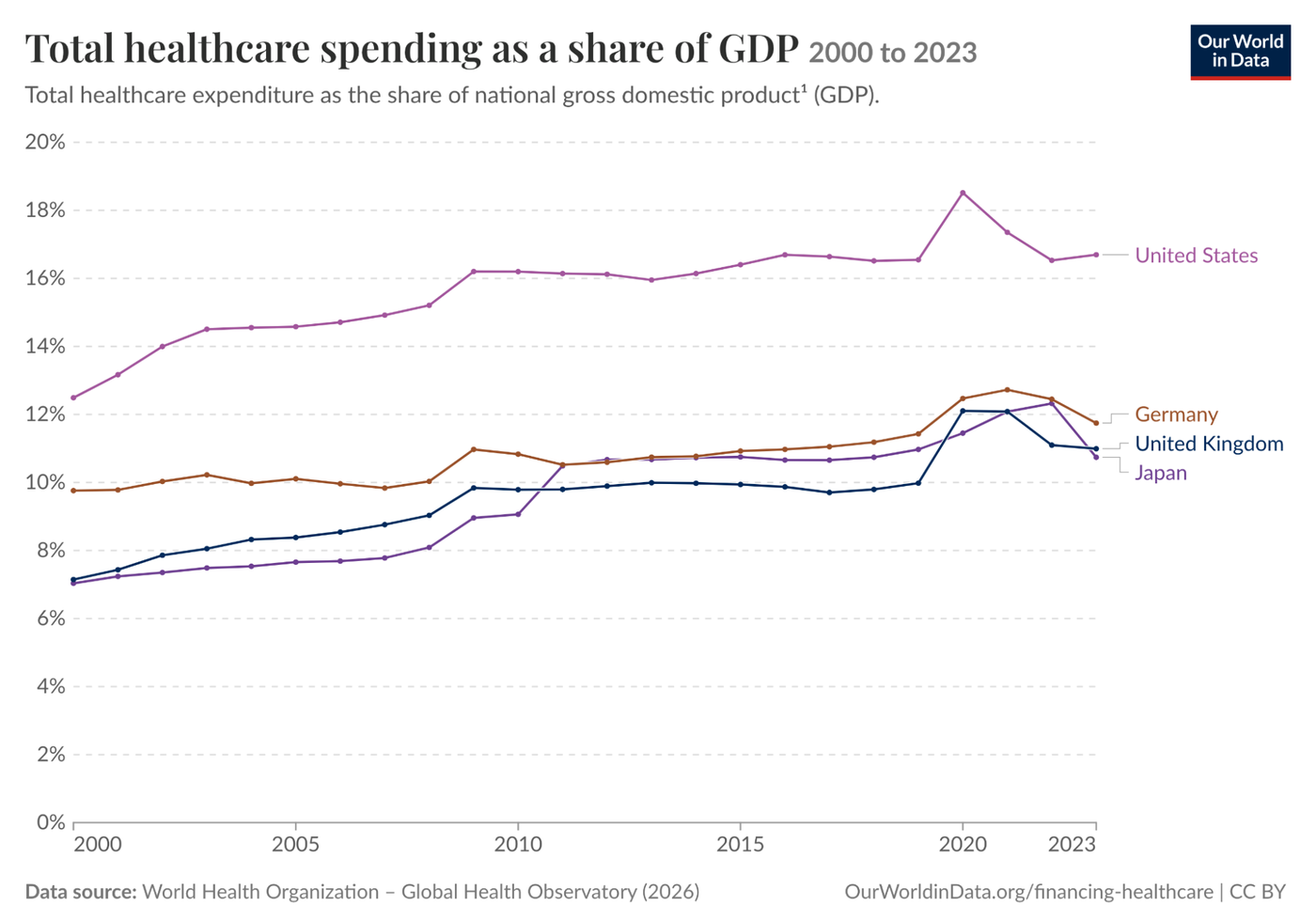
Getting richer makes folks need extra healthcare, in every single place. Nobel winner Robert Fogel measured that for each 10 % richer we get, we spend about 16 % extra on well being. So well being takes a much bigger share of each elevate. You’ll be able to see it throughout the massive economies. The U.S. went from about 5% of GDP in 1960 to 18% in 2024, and the UK, Germany and Japan climbed too. The UK runs a nationwide well being service, Germany makes use of nonprofit illness funds, and Japan has hundreds of insurers, but the road goes up anyway. The climb tracks getting richer greater than how anyone nation pays for care.
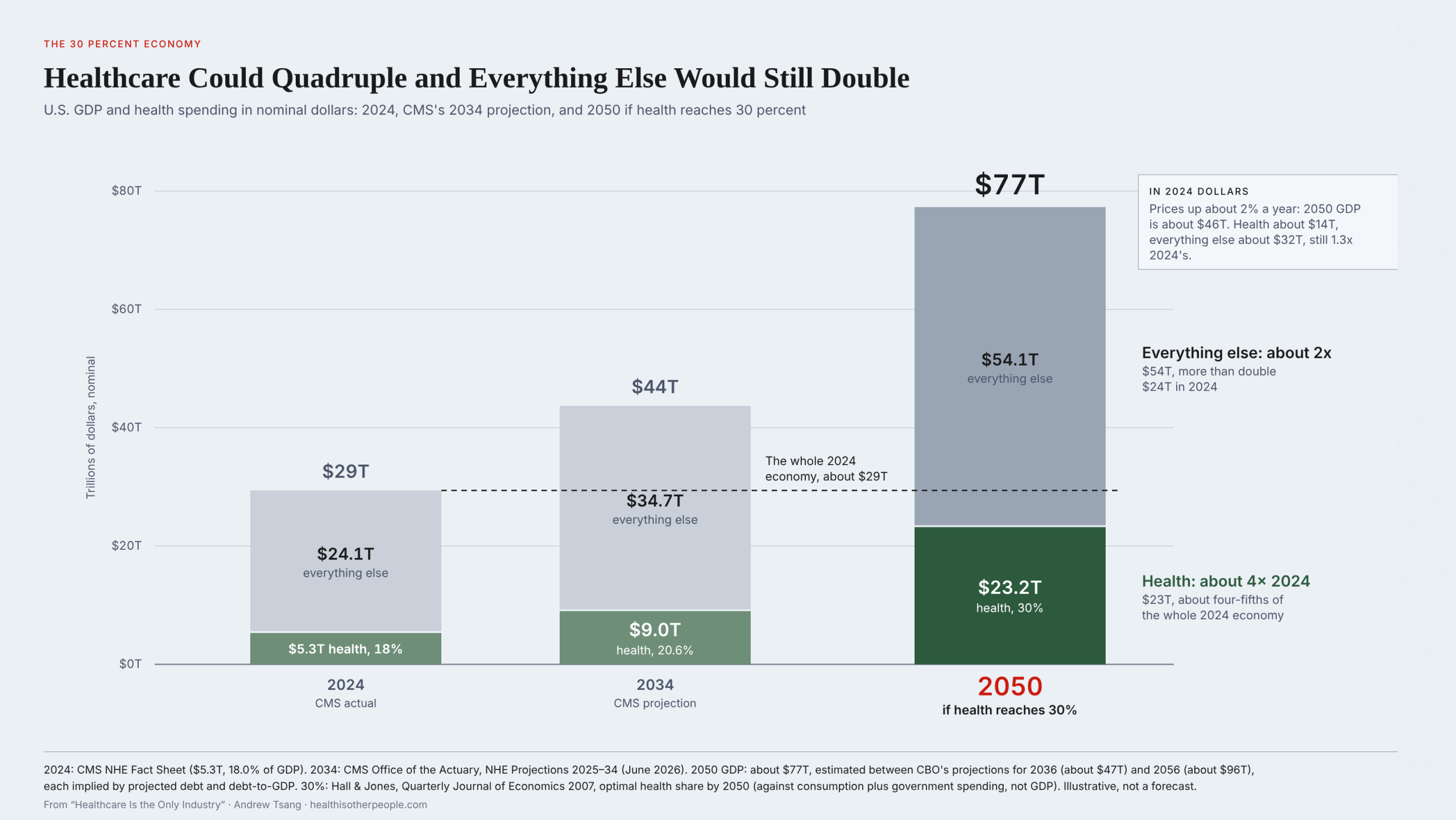
America has discovered its personal approach to make care costly – but it surely’s not alone in its demand for healthcare. There’s a wild paper by Stanford economists Hall and Jones explaining why the demand grows. Every additional factor we purchase provides rather less, whereas every additional yr of life offers us extra time to take pleasure in the whole lot we already personal (by that logic, Amazon ought to preserve us alive to purchase extra stuff). Of their mannequin, one of the best share for well being retains rising with revenue and passes 30% by 2050. Even at 30%, healthcare could be almost the dimensions of right now’s complete economic system, and the whole lot else would nonetheless be twice as massive as it’s now.2 The query is whether or not we’d gladly spend a 3rd of our economic system on extra wholesome years.
I can run out of issues I need to purchase lengthy earlier than I run out of issues I need to do. One other wholesome yr offers me time with my youngsters, time to jot down, time to make use of what I already personal – and if I’m grasping, purchase extra stuff. However as we get richer, a 3rd TV provides nearly nothing – yet one more wholesome yr provides nearly the whole lot. We cease wanting extra for our time and begin wanting extra time for what we have now. That’s what financial progress is meant to purchase. I care concerning the work folks can do once they’re wholesome, and I additionally care concerning the days they will spend doing completely nothing helpful to an employer. The purpose of one other wholesome yr is that you just get to have it.
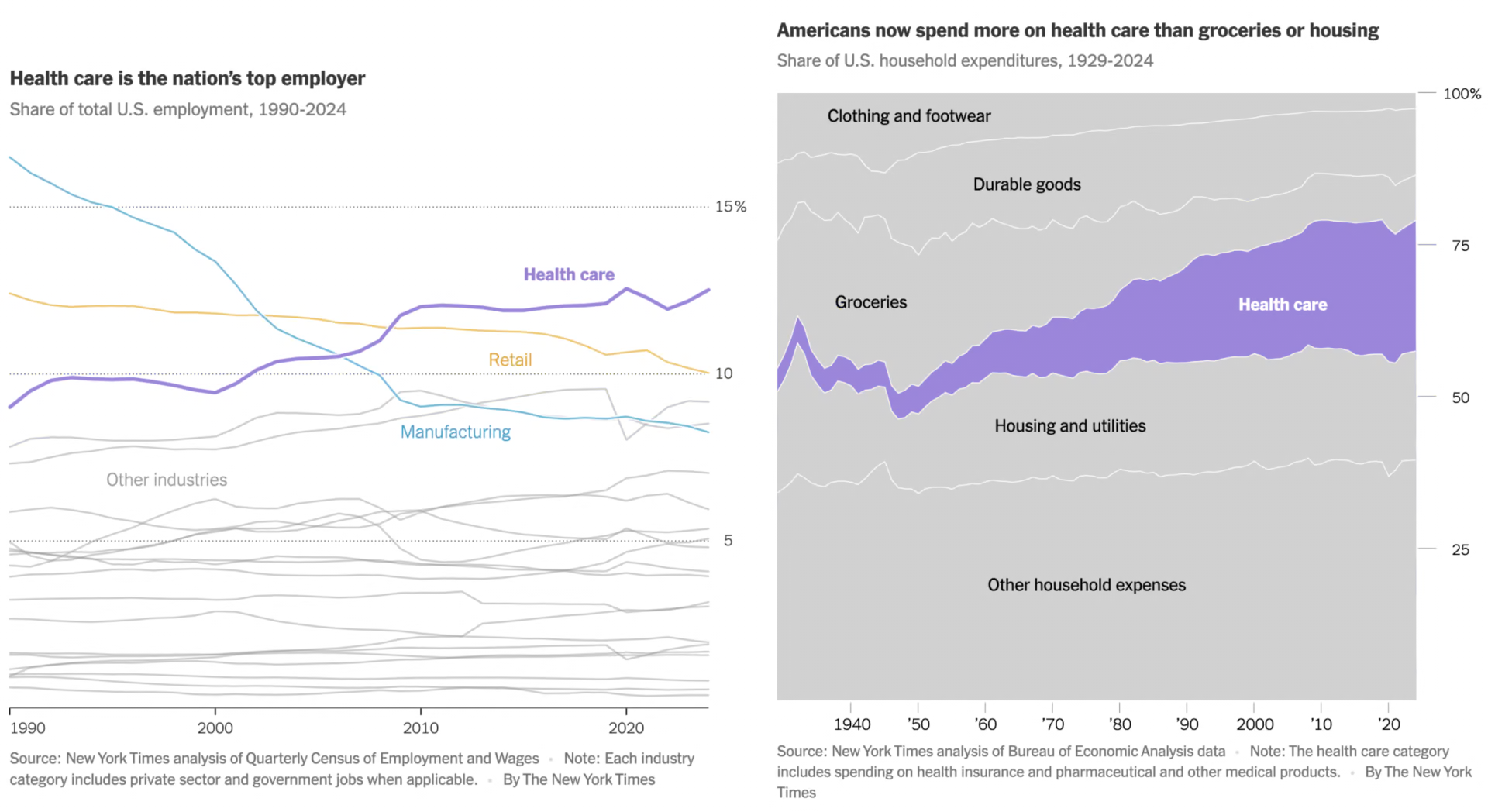
The cash is just half of it. Healthcare is now the nation’s biggest employer, ahead of retail, with about one in eight American employees. An economic system that wants fewer folks making fridges can afford extra folks serving to somebody get off the bed.
Extremely Massive and Very Quick
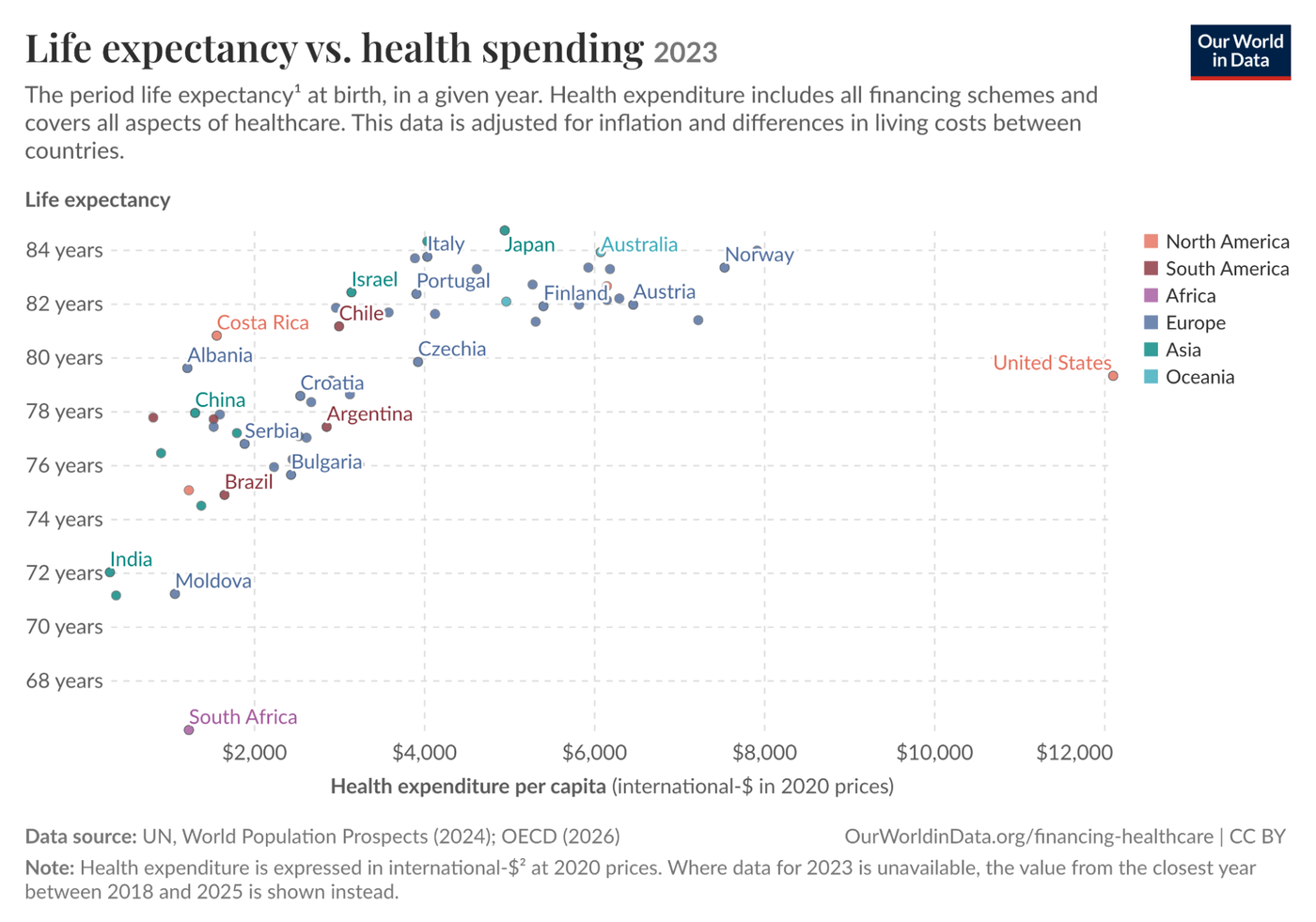
The plain objection is that America already spends an excessive amount of and will get too little for it – which is a good argument in opposition to healthcare progress. We’ve got managed to make a really massive business really feel like a scarcity. America spends extra on healthcare than any nation on earth, almost twice as much per person as comparable wealthy countries, while getting about half as many in-person doctor visits. Attempt discovering a main care physician taking new sufferers, or a therapist, or a nurse with time to sit down down. No different business could be the largest factor within the economic system and nonetheless go away folks ready in line. However the line isn’t there as a result of we wish an excessive amount of care.
A part of the wait comes from work solely an individual can do, and an individual can’t be sped up or break up between two beds. This impact is finest demonstrated within the basic (and classical) instance of a string quartet: It wants the identical 4 gamers and the identical time to play Mozart’s No. 19 in C because it did 250 years in the past, but it prices much more, as a result of the musicians’ pay has to compete with the fashionable labor market. A hospital nonetheless wants somebody to assist a affected person eat, wash and get well, and that individual’s pay has to maintain up with the manufacturing unit down the street, the place the identical work takes fewer arms yearly. This financial impact is extensively referred to as Baumol’s cost disease. In typical healthcare discourse, it often will get cited as a demise sentence—proof that care prices will climb till they eat the entire economic system. William Baumol himself wrote a whole book saying that folks get it backwards, with a chapter titled “Sure, We Can Afford It” (we must always simply finish the essay right here). Care solely appears to be like pricier as a result of the whole lot else retains getting cheaper. A nurse’s hour prices extra annually as a result of each different hour received extra productive, and that very same productiveness is what makes us wealthy sufficient to pay her.
Now I gained’t defend the effectivity of US healthcare spending, as a result of an excessive amount of of the cash by no means reaches the care. I’ve written lots about healthcare waste, market power, and the elaborate business of getting someone else to pay. We will reduce the work of disputing a invoice with out chopping the time a nurse spends with a affected person. Paying extra folks to look after us, and paying extra to get previous the billing division, each present up as healthcare spending. A $5+ Trillion complete is impressively massive, but remarkably ambiguous about telling us which form of healthcare system we purchased.
So reduce the waste, and spend each greenback it frees up on care. Even at $5+ trillion, healthcare is chump change subsequent to the years it buys when it really works, and the folks it retains properly sufficient to make use of them.
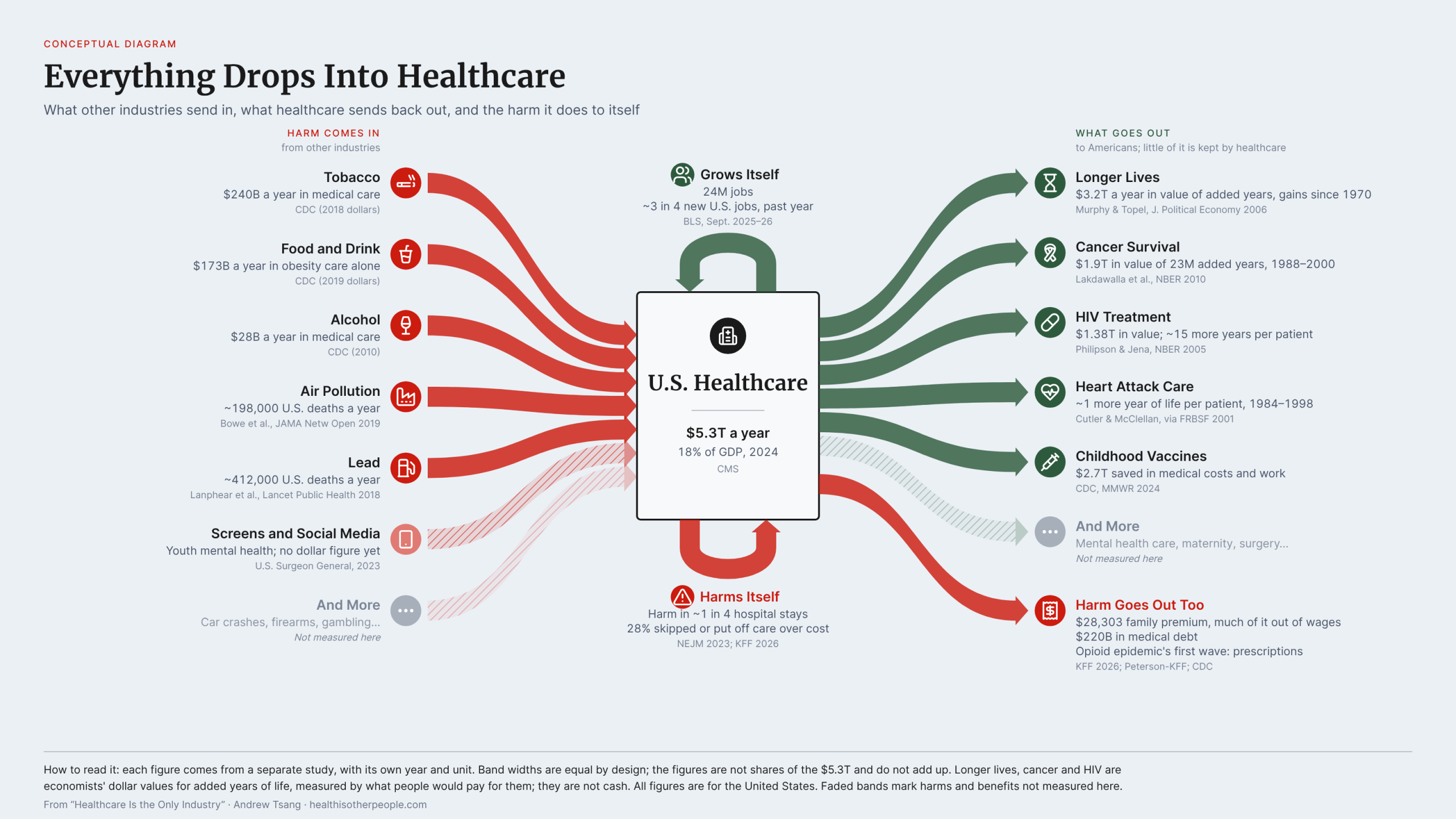
Every little thing Drops Into Healthcare
Healthcare can also be the one business that takes everybody else’s shit. Each different business will get to promote its product and stroll away. No matter that product does to the individuals who purchased it—the smoke, the sugar, the air pollution, the job that wore out a again—results in a clinic or a hospital mattress. And no matter healthcare returns—the child who makes it to high school, the guardian who makes it to work—will get booked to any person else. Healthcare carries the expense coming and going. No different business sits on the backside of the economic system like that, catching what falls and sending folks again up.
The Financial Return
Let’s begin with what flows out of the system. When my child is just too sick for college, my workday modifications too. My insurer can rely what it paid for the go to, but my shoppers and the college don’t ship it a examine for the difficulty they have been spared. Financial research on vaccination (plz don’t @ me) allow us to measure the impression. For American youngsters born from 1994 by means of 2023, the CDC figures vaccines cost us $268 billion and saved $2.9 trillion. That’s $2.7 Trillion we received to maintain, and most of it by no means touches a medical invoice. We pay for the shot and the work of getting it into an arm. The return contains youngsters who by no means get sick, dad and mom who don’t should miss work, and lives that aren’t reduce brief. A healthcare funds pays for advantages that different folks’s budgets get to maintain.
1 With apologies to Don Berwick’s Triple Aim, value is the primary downside in U.S. healthcare. Entry and high quality are issues too, however value and affordability are at a boiling level. I’ve written extensively about it here, here and here – so for those who’re pondering I’m advocating for extra value progress, take into account this essay my satan’s advocate scorching take.
2 Fast maths: CMS places 2025 well being spending at $5.7 trillion, 18.4% of GDP, so the economic system is about $31 trillion (give or take). CBO’s long-term outlook implies an unfathomable $96 trillion of GDP in 2056, so 30% of that’s about $29 trillion in healthcare spending. The opposite 70% is about $67 trillion, greater than twice right now’s complete economic system. The tough half is that these are nominal {dollars}, and Corridor and Jones measure the well being share in opposition to consumption plus authorities spending, a barely totally different base from GDP.
Andrew Tsang is a guide at Longitude Healthcare Partners and writes about healthcare at his weblog, Health Is Other People. Half 2 is here.
