


By ANDREW TSANG
(Half 1 is right here)
The Healthcare Economic system’s Smoking Gun
That’s the beneficiant aspect of the accounting, the place healthcare produces advantages different industries get to maintain. The opposite aspect coming in exhibits that healthcare treats harm different industries receives a commission to trigger. Because of measurement alone, tobacco use is the perfect instance. A cigarette firm books a sale and retains the revenue. The lung illness exhibits up years later, in a clinic, on an insurer’s declare, in a hospital mattress, and the corporate by no means sees that invoice. Cigarettes are a textbook instance of a unfavorable externality, a product whose hurt lands on individuals who have been by no means a part of the sale. Smoking generated more than $240 billion in healthcare spending. The invoice obtained large enough that states sued the tobacco corporations to claw again the general public cash spent treating people who smoke, and a 1998 settlement with forty-six states nonetheless has them paying. It took a nationwide authorized battle to ship even a part of smoking’s invoice again out of healthcare.
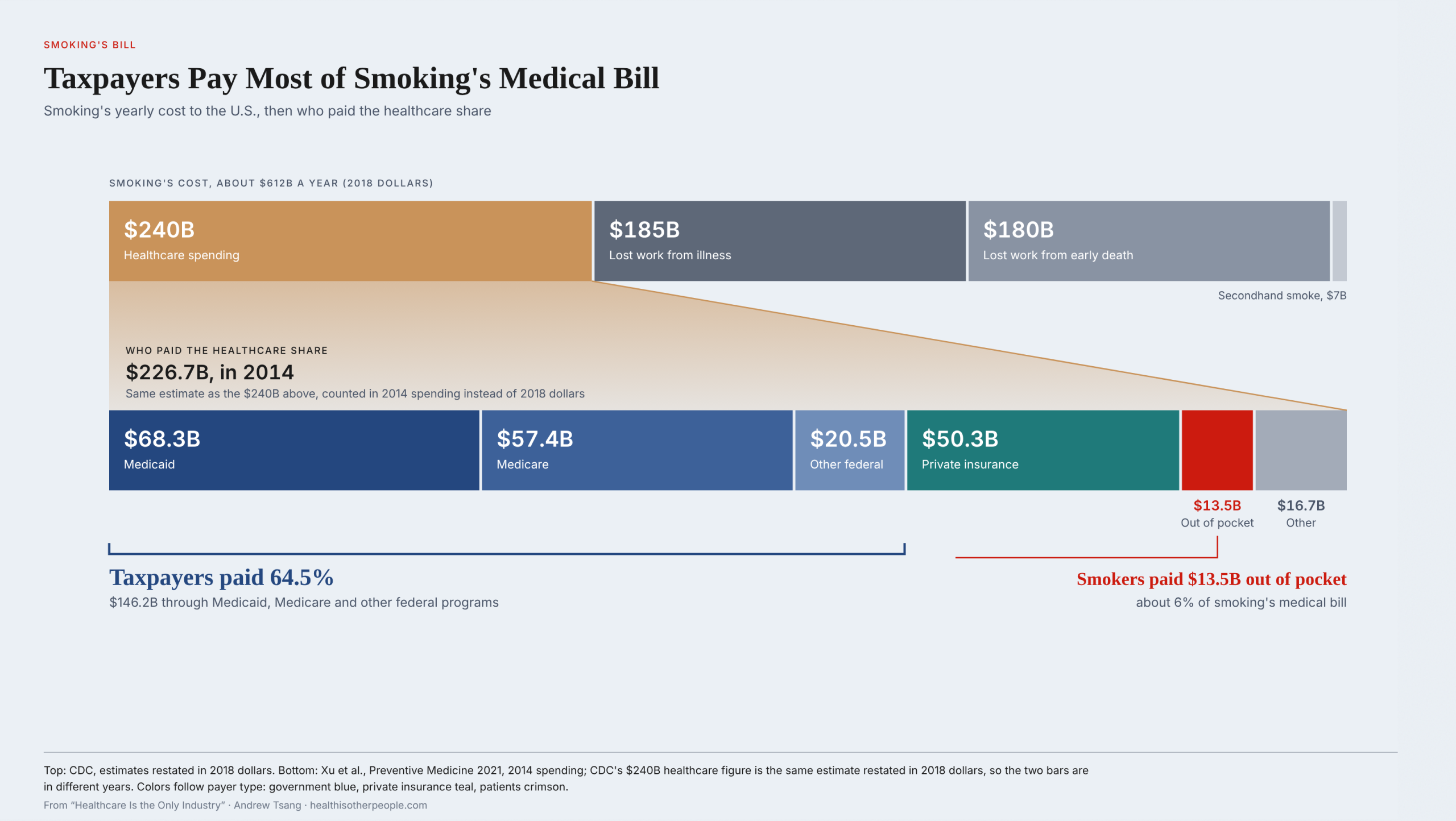
A part of what we name healthcare’s price downside is de facto the price of everyone else’s merchandise. The smoker’s most cancers remedy nonetheless enters the accounts as healthcare spending, the place it joins the proof that healthcare prices an excessive amount of. Sure – hospitals can overcharge, insurers can overburden, and medicines will be overprescribed. However this affected person arrived with a illness a cigarette firm was paid to trigger! Fixing the billing division gained’t undo what put them within the mattress.
Tobacco simply occurs to be the one we sued to recoup healthcare prices. Practically every little thing this financial system sells comes with a aspect impact, and each aspect impact clogs up a ready room. We eat meals that’s manufactured to be addictive – and weight problems alone is tied to $173 billion in annual medical costs. We breathe regardless of the plant upwind is burning. We drink water the place forever chemicals show up in nearly half the taps in the country. We hand our children telephones filled with feeds and adverts constructed to maintain them scrolling. Every of those industries offered one thing folks wished, and healthcare obtained the sufferers. There’s no grasp funds to take care of the hurt of the drive-thru, the smokestack, the water predominant or the feed (each livestock and algorithm). Researchers can solely measure a few of these harms, and the measurable ones alone hint to about a quarter of every little thing America spends on healthcare. Healthcare is the one trade that has to soak up all of it, and each greenback will get counted as healthcare’s price.
The Dwelling for Healthcare
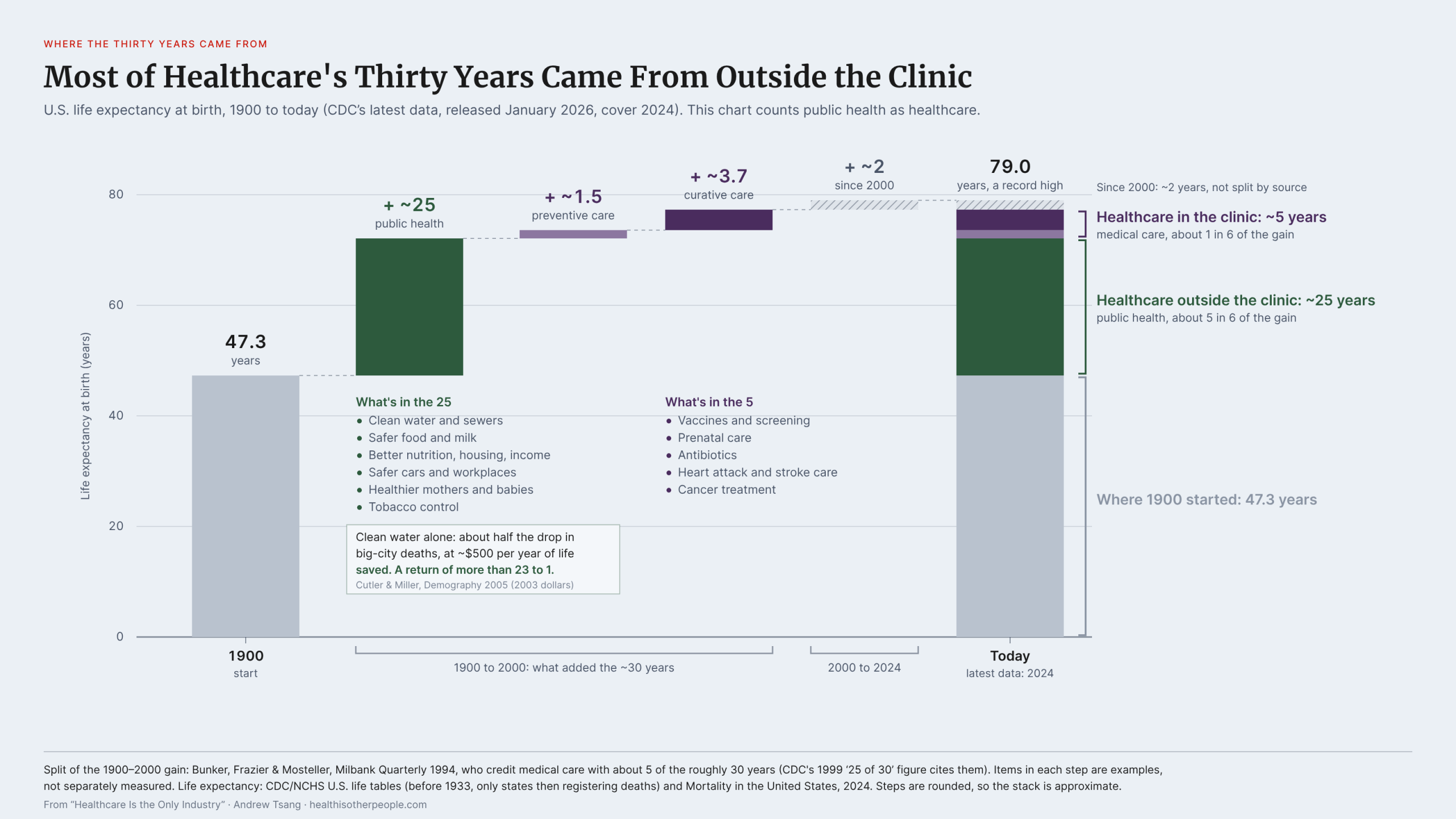
The way in which these unfavorable externalities are normally addressed is thru public well being. Clear the water, tax the cigarettes, put guardrails on the freeway, and fewer folks find yourself within the hospital. Ergo, that spending is healthcare spending too. Each greenback spent stopping the harm continues to be a greenback spent on well being, so even the repair makes healthcare larger. It simply buys the years upstream, earlier than anybody wants a mattress.
If healthcare receives the harm, the following query is whether or not it ought to pay to stop a few of it – medicalization can be a philosophical query slightly than a practical one. Housing is the place that query has the perfect proof. In Denver, a program supplied folks experiencing persistent homelessness and frequent arrests a everlasting place to reside, rental help, and help to assist them keep housed. Locations have been supplied at random, so researchers may evaluate the 2 teams. Amongst these whose care may very well be tracked by means of Medicaid, the housing group had fewer emergency-department visits and more office-based psychiatric care over two years. Giving folks a house modified the care they wanted. I don’t know that each housing program saves medical {dollars}. However as soon as housing adjustments the necessity for hospital care, the road between a housing funds and a healthcare funds will get blurry.
So medicalize it. If the expansion in healthcare spending bothers you, the repair is extra of it, aimed upstream on the social determinants of well being—the housing, meals, revenue and security that form our well being lengthy earlier than we ever see a health care provider. Working with healthcare organizations to construct packages round them was one among my greatest experiences. It provides duties to a system already scuffling with those it has, and I nonetheless assume it ought to lean all the way in which in. We are able to exclude housing, meals, and revenue from healthcare’s definition. We can’t exclude their penalties from the hospital, so we’d as nicely pay for them earlier than they get there.
So the place does healthcare cease? I might argue that it doesn’t. Folks preserve discovering new methods to get harm, and every one turns into one thing healthcare has to deal with. That’s a part of why the invoice retains rising, and it’s why the boundary retains transferring. Healthcare retains turning into extra of the financial system as a result of extra of the financial system seems to be healthcare. So healthcare will continue to grow into what we pay it to do.
Rising Up
Whereas engaged on both sides of the healthcare payment process, I’ve realized to grasp why a hospital payments for a examine and an insurer checks the invoice. Give every an AI system and the hospital can doc extra of the care it could actually invoice for whereas the insurer scrutinizes extra claims. Every group can develop into extra productive at making work for the opposite. A sooner attraction meets a sooner denial, and the one factor that grows is the paperwork.
Healthcare is headed from 18% towards 30% both method, so the query is what that progress buys. In the present day we largely pay per go to, per check and per declare, and a apply paid per go to will spend no matter time AI saves on extra visits. Paid that method, healthcare additionally grows its personal hurt, in medical debt, skipped care and infections picked up within the hospital. Pay the identical apply to maintain folks nicely, and the time goes again to sufferers. Spent on years of life – that 30 p.c could be the perfect funding the financial system has ever made. Spent on claims and denials – it’s the disaster everybody retains warning about. And if housing is healthcare and meals is drugs, extra of the financial system is about to be paid per go to and per declare too. That’s the cost mannequin to repair earlier than AI speeds it up.
We seldom pay healthcare so as to add years of life, as a result of whoever pays for the care isn’t the one who collects. A well being plan pays for blood strain capsules at this time. By the point the capsules repay, the affected person has switched plans, and the wholesome years go to an employer and a household who by no means noticed the invoice. That’s the identical misbooking that makes healthcare appear like it’s failing. Prevention has it worst, as a result of the hurt it stops by no means exhibits up in anybody’s information. Chesterton’s rule is to not tear down a fence till you understand why it was constructed, and prevention is the fence that appears pointless as soon as the animals cease entering into the yard. A cost system that solely pays for what it could actually rely will preserve shopping for claims. Pay for the years healthcare provides, and invoice the industries that ship the hurt in.
Baumol isn’t the one economist healthcare will get improper. In 1865, William Jevons seen that as steam engines obtained higher at utilizing coal, Britain burned extra of it. That normally will get cited as a warning that effectivity backfires – the identical method Baumol will get cited for instance of healthcare inefficiency. The misreading is that every time care will get cheaper – we simply use extra of it, and the invoice goes up. However in healthcare, extra use will be the purpose. AI is about to try this to every little thing it touches.
Actually, productiveness by itself is meaningless. An financial system that doesn’t produce something good for all times doesn’t matter. Think about AI writing one million adverts, one other AI deciding the place to put them, a 3rd producing the pages they seem on, and a fourth summarizing these pages so I don’t should learn them. Extra output, extra invoices, extra money for the house owners, and someway I nonetheless have to shut a pop-up. Low-cost adverts get us extra adverts. In healthcare, a budget unit can be no matter we pay for. If that’s care, Jevons is nice information, as a result of extra well being is arguably the entire level. If it’s claims, then we get extra claims. No matter we’re paying for when AI arrives is what it can multiply.
The Human Business
Automation can do extra for care than pace up the invoice. AI will let many of the financial system make extra with fewer people, the way in which the manufacturing facility did, solely sooner. When it succeeds, we are able to afford to have extra folks doing work that also wants them, and healthcare is the place the freed-up cash and other people ought to go, as a result of its product is time with people and extra years to spend. Serving to somebody get away from bed is one use for that capability. Giving a nurse sufficient time with the affected person already within the mattress is one other. The Bureau of Labor Statistics projects that healthcare and social work will be about 37% of new American jobs from 2025 to 2035. A lot of that demand comes from growing older and persistent sickness. I don’t have a good time folks needing extra care, however I do need an financial system that may present it. A remedy ready to be invented and a remedy ready for an obtainable nurse symbolize totally different shortages. An financial system that may afford the invention must have an ambition for the nurse.
So right here’s my reply to the query I began with: sure, the purpose of getting richer is to purchase extra life. Healthcare is the one trade whose product is extra human life, the one one which takes in everybody else’s harm, and the place our cash and other people ought to go as machines take over the remainder of the work. Thus we’re left with an existential dilemma—ensuring healthcare’s progress buys extra life and fewer enterprise. Healthcare is headed for a 3rd of the financial system whether or not we plan for it or not, and what we pay it for decides whether or not that third buys years of life or extra paperwork. So reduce the waste, pay for the years it provides, level the machines on the bedside, and cease apologizing for its measurement. Strip away every little thing else. What does that go away?
The one trade that takes the smoker after the cigarettes are offered – and tries to present him extra time.
The one trade that sends folks again to work, again to high school, and again to their very own lives – but by no means sees the return.
The one trade that also wants an individual on the bedside, and may lastly afford one as soon as the machines do the remaining.
The one trade that pays folks to take care of different folks – and has to maintain selecting them over the invoice.
The one trade that turns into no matter we pay it to be.
The one trade that’s headed for a 3rd of every little thing we make – and rightfully so.
The one trade that welcomes you into the world, spends every little thing in between making an attempt to present you extra – and tries to make leaving it much less painful.
Healthcare is the one trade that issues.
Andrew Tsang is a marketing consultant at Longitude Healthcare Partners and writes about healthcare at his weblog, Health Is Other People.
